"They hung a sign up in our town:
If you live it up, you won't live it down."
- Tom Waits
Seeing
this rant that David Simon gave, I was reminded of how strongly regional his work is: Treme, for all it flaws (like the fact that 2 out of 3 actors are downright unwatchable) is so embedded in New Orleans that it's hard not to feel a familiarity with the city's streets, people, and music. There was a period in the late 90s when I hung out with a group of friends from New Orleans, and so when I first watched Treme, I was thinking about them - wondering how I lost touch - when lo and behold, one of them popped up on the show.
It was a bizarre coincidence for me, but also a potent reminder of how deep Simon's work goes, how important it is for him to get local, to find the actual people that live somewhere (which can always backfire - hence the horrendous acting moments), to go to real locations, and to write within the slang.
Regionalism is recognized in literature, but in television it doesn't exist. And in film it's generally a bonus, not a defining characteristic. Indie filmmakers have managed to tap into some sub-cultures well (I recently saw
George Washington and
Shotgun Stories - both great examples). And there are mainstream exceptions - Ben Affleck is practically a cottage industry of Boston films. But for the most part, on any given screen it's still New York and LA. New York and LA. New York and LA.
Or films exist in a nameless American concept-space: a suburb, a city, a western landscape. Sometimes this is intentional - I heard Fincher wanted both Seven and Fight Club to be set within a kind of "every city" - but I think it's usually because films are shot in Canada. Or New Mexico. Or wherever the latest state sponsored tax breaks have been instituted.
Here's the Cliff Notes version of how that works: states give huge tax breaks to film productions in order to bring money to local businesses and provide jobs for local crew workers. What Hollywood invariably does is spend a few years taking advantage of these breaks, then when the local crew gets unionized or talented enough to demand a living wage - they either get exported to Hollywood or Hollywood moves on to the next right-to-work state.
This a pretty sad reason to choose locations for filming. The setting for a film or TV show really shouldn't just be a backdrop, because - as my good friend and mentor (and big David Simon fan)
Tod Goldberg is fond of saying - place defines character. I thought about this when I saw Avatar and wondered why Sam Worthington wasn't just left Australian. I mean, his primary identity is "human from the planet Earth" but they still felt the need to neutralize his voice into a flat, generic American-speak. Maybe this will change as we lose our super-power status among nations, but so far, even with a global film like Avatar, directors feel compelled to keep the characters generic. We gotta have an All-American hero. And All-American in movies still means white, and absent of any localizing attributes. In Avatar, even the guy's tattoos are just black and vaguely celtic/tribal - a kind of "every tattoo."
I bring this up because Shiloh and I have recently been asked to screen Irish Twins in Sonoma County - where we grew up, and where we located the film. (I'll post details about the screening as soon as I have them.)
This will be the first time we play Northern California - well, first time north of the very cool
Big Sur Film Festival, which is probably the southernmost point of NorCal - and I have to say, its been a disappointing reality check that our home region has been pretty universally uninterested in our work.
We wrote Irish Twins to be set in a kind of mythic version of our home county: there were references to specific local spots and we wanted the look and feel to be as Northern Californian as possible. So we made it our goal to shoot up there. We had no idea the uphill battle we were facing.
Irish Twins primarily takes place in a bar. How hard could it be to find a bar, right? Well, everywhere in Sonoma County turned us down. I spent many a weekend driving around the whole county, walking into bar after bar. If the look and feel of a place was right, I would talk to the manager. The very few that seemed amenable at first would eventually refuse to return our calls or outright turn us down.
In many ways, this is understandable: having a film shoot in your place of business can be a pain in the ass. But we were willing to work around their hours and pay them. My favorite response was when one bar wouldn't let us shoot from 2am (after closing) until noon - because they normally opened at 6am. They didn't want to cut the morning hours because they "couldn't do that" to their "customers." Really? You can't so that to all those people getting a drink at 8:14 on a Tuesday morning? What if we set up a keg in the parking lot? Would they be willing to be extras?
Which is part of what makes our hometown so great: they don't give a shit about Hollywood. They're not impressed just because some guy walks in and says he wants to make his movie there. But it's frustrating when you consider yourself a proponent of localism and you're treated like an intruder. There are times when "not being impressed" morphs into reverse snobbery: a reaction to the presumed superficiality, materialism, and exploitative tendencies of Southern California. Shiloh and I wanted to be champions of local film and we were being told over and over again that we were interlopers.
We wanted to use local crew as much as possible - but the San Francisco folks charged more than their LA counterparts, and we would have to cover their expenses to leave the city and drive a couple hours northward. It wound up cheaper to drive a crew up from LA in a van and pay for hotels.
Then there was the question of permits. We had a hell of a time trying to get the right person at the right department to give us permission to shoot at one of the public exteriors we wanted. When we couldn't get the official nod, we were finally told - pulling out our hair in terror only hours before we planned to shoot - "You know, our people rarely go to that site to check permits." Which, absent of any options, we took as code for "we'll look the other way."
Every step during this process, our producers stuck by our vision - at any point it would've been a lot easier for them to tell us, "Guys, just make it take place in LA" or "Can't this just be set in a generic suburb?" But these were characters we had forged out of a conception of our home. We wanted it to look like we imagined it.
So in the end, we had to shoot the interiors in LA, and we squeezed all of our exteriors into one long day of shooting in NorCal. When we shot outside the one bar we did get permission to work in front of - because we didn't screw with their business at all - we had to contend with the patrons coming out to kick our cones into the street and yell at us drunkenly. (On a lighter note, the local fire department was awesome - they let us shoot in front of their station and use one of their ambulances.)
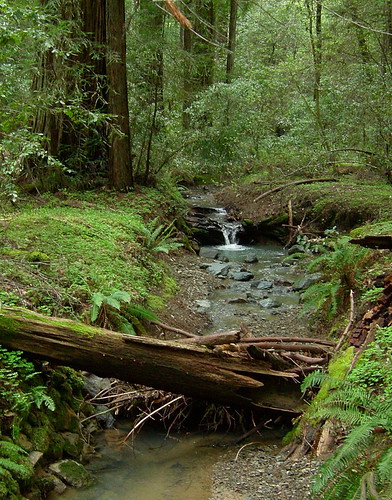
But OK, at least we were able to capture the look we wanted: scenes in a redwood forest, a swooping jib shot along our favorite-looking bridge at sunset, a nice drop down into a street to see the kind of small town we envisioned. Almost exactly as we had hoped - our film would still take place in NorCal even if we couldn't shoot the whole damn thing there and support the local film community.
After it was done and we began to play festivals, I hoped we could come home and play one of the many film festivals that take place in the area and have our friends and family come out to see it on a big screen.
But we submitted our short to every Northern California film festival we could find...and not one acceptance.
I wrote cover letters explaining where we grew up, that we wouldn't be anywhere as professionals if it weren't for our local community center or the summer acting classes we found as kids. That we loved the fact that there were good festivals in the region.
Nope. We were summarily turned down - we didn't even get a rejection letter from one of the festivals (and yeah, I'm going to say their name here: Napa Sonoma Wine Country Film Festival - they took our submission fee and didn't even send a form letter to say, "Sorry, ya didn't make it" - pretty classless in my opinion).
All of which is totally understandable and entirely their prerogative and only sucks for one reason: I want to live and work in Northern California! I want a thriving independent artistic community up there that includes film! That includes me!
But alas, many people more powerful and noble than me have tried this very thing. Like a guy named Coppola. Or George Lucas. Outside of the Lucas Ranch (which, let's face it, isn't much of a film community, it functions as an utterly self-contained mini-studio-compound), no one's been able to bridge the LA-NorCal entertainment divide.
Maybe once that high speed train is built - then everyone that lives in Malibu will escape to San Francisco. God, that's a terrifying thought.
I spent my entire adolescence hating LA - I was working five days a week down here and yet still flying home every weekend to be with my friends and family. It would have been a lot easier for me to go to high school down south, but my parents strove to keep me rooted up north. Which has made it tough as an adult to stay in LA, but the truth is...there's just not enough work up there.
So until Shiloh and I have the kind of financial backing to pay those bar owners, film permit offices, and crew members what they need - we'll have to shoot elsewhere. Which is probably what Northern California wants in the end; maybe the whole region is saying, "Don't bother us until you're serious." They don't want weekend warrior filmmakers. They don't want to be the latest tax-break haven for LA to burn through. I can understand that.
In the meantime, we'll continue to tell stories that we care about, and undoubtedly some of them will cover those specific places and people we grew up with and that we still cherish. Like
Bodega Bay.
Downtown Occidental.
Armstrong Redwoods. Top of the World.
I guess we'll just have to fake those locations for now.
You know, Oregon has no sales tax...